
Research Article

Journal of Korean Institute of Architectural Sustainable Environment and Building Systems. 30 October 2026. 394-411
https://doi.org/10.22696/jkiaebs.20260032

ABSTRACT


MAIN

  • 서 론

  • 연구 방법

  •   연구설계 및 분석자료

  •   기술별 요구 조건 정리

  •   적용조건의 범주 구성과 문항 분류

  •   전체 문항의 연구자 간 분류 일치도 분석

  •   의사결정 지원도구의 구성과 판단 기준

  •   사례 적용과 도구의 계산 점검

  • 분석결과

  •   현장 실증 적용조건의 구성

  •   전체 66개 문항의 연구자 간 분류 일치도

  •   지원도구의 사례별 결과

  •   판단 규칙의 구현 결과

  • 논 의

  •   기존 체계와의 관계 및 연구의 기여

  •   현장 적용과 가이드라인 활용

  •   연구의 한계

  • 결 론

서 론

공동주택의 에너지 사용 저감을 위해 실내환경, 재실 및 에너지 사용 정보를 활용하여 냉난방·환기·조명 등의 운전을 조정하는 기술이 개발되고 있다. 이러한 기술을 기축 공동주택에 적용하려면 개발단계에서 정한 요구조건과 대상 건물의 설비·통신·계측 환경을 함께 확인해야 한다. 기축 건물의 스마트 개조와 시스템 연계에 관한 연구에서도 기존 설비에 새로운 센서와 제어 기능을 연결하는 문제가 주요 과제로 다루어졌다(Domingues et al., 2016; Peiris et al., 2023; Akbulut et al., 2025).

Lee et al. (2025)는 공동주택의 설비와 통신 인프라를 바탕으로 BEMS 적용성을 분석하였고, Ha et al. (2025)는 현장조사와 인터뷰를 위한 조사 도구를 제시하였다. Kwak (2013)은 기존 사무소 건물의 BEMS 적용 타당성 평가과정을 다루었다. BEMS 운영자료를 활용한 연구에서는 운전상태와 전력 소비특성을 분석하였으며(Park et al., 2018; Hwang et al., 2020), 데이터 기반 기술의 현장 적용에서는 센서, 기존 시스템과의 연결 및 성과평가 여건을 함께 갖추는 일이 중요하게 다루어졌다(Gunay et al., 2025).

현장조사에서 설비가 있는 것으로 확인되어도 필요한 데이터를 수집하거나 외부에서 제어명령을 실행할 수 있는지는 별도로 확인해야 한다. 또한 확보한 자료가 기술에서 요구하는 시간 간격을 충족하는지, 추가 장치의 설치가 가능한지, 평가기간에 대상 시설이 실제로 운영되는지를 검토해야 한다. 따라서 조사결과를 실증계획에 활용하려면 기술별 요구조건과 현장기록을 비교하고, 확인된 부족사항과 미확인 사항에 대해 다음 조치를 정하는 절차가 필요하다.

본 연구는 기축 공동주택 에너지관리 기술의 현장실증을 준비할 때 사용할 수 있는 의사결정 지원도구를 개발하고, 두 후보단지의 조사자료에 적용한다. 먼저 공통 체크리스트의 66개 문항을 여섯 적용조건으로 분류하고 연구자 간 분류 일치도를 확인한다. 이어 기술별 요구조건, 현장 확인결과 및 보완 가능성을 연결하는 판단 기준을 구성한다. 이를 스프레드시트로 구현하여 검토결과와 필요한 조치를 함께 제시하고, 후보단지 기록을 이용해 도구의 사용과 판단 과정을 설명한다.

연구 방법

연구설계 및 분석자료

분석자료는 에너지관리 기술의 실증을 준비하기 위해 작성된 현장조사표와 기술자료이다. 체크리스트는 참여기관이 제시한 기술별 확인사항을 주관기관이 취합하여 작성하였다. 두 후보단지에 공통으로 사용한 66개 문항을 분석대상으로 하였으며, 공용부 44개와 세대부 22개로 구성된다. 문항은 한 번씩 집계하고 단지별 응답과 특기사항은 현장 여건 비교에 활용하였다. 기술자료와 실증 추진 기록을 함께 검토하여 문항의 의미와 조건부 응답을 해석하였다(Table 1).

Table 1.

sources and their roles in the analysis

Data source Main contents Analytical role
Field-survey checklists for Sites A and B 66 shared items, site responses, and explanatory notes Primary dataset for item classification and comparison of site conditions
Technology and sensor/device specifications Required input variables, data collection intervals, outputs, and control variables Identification of technology requirements
Experimental constraints and demonstration considerations Data limitations and issues affecting measurement, control, and installation Interpretation of technical constraints and unresolved questions
Technology briefing and demonstration planning meeting materials Proposed equipment, integration methods, and site-specific implementation issues Comparison of technology requirements with recorded site conditions
Demonstration recruitment and coordination records Resident participation, installation, visits, and maintenance constraints Interpretation of operational conditions affecting demonstration planning
Candidate-site inventory and selection records Site characteristics and available infrastructure Background information for candidate-site screening

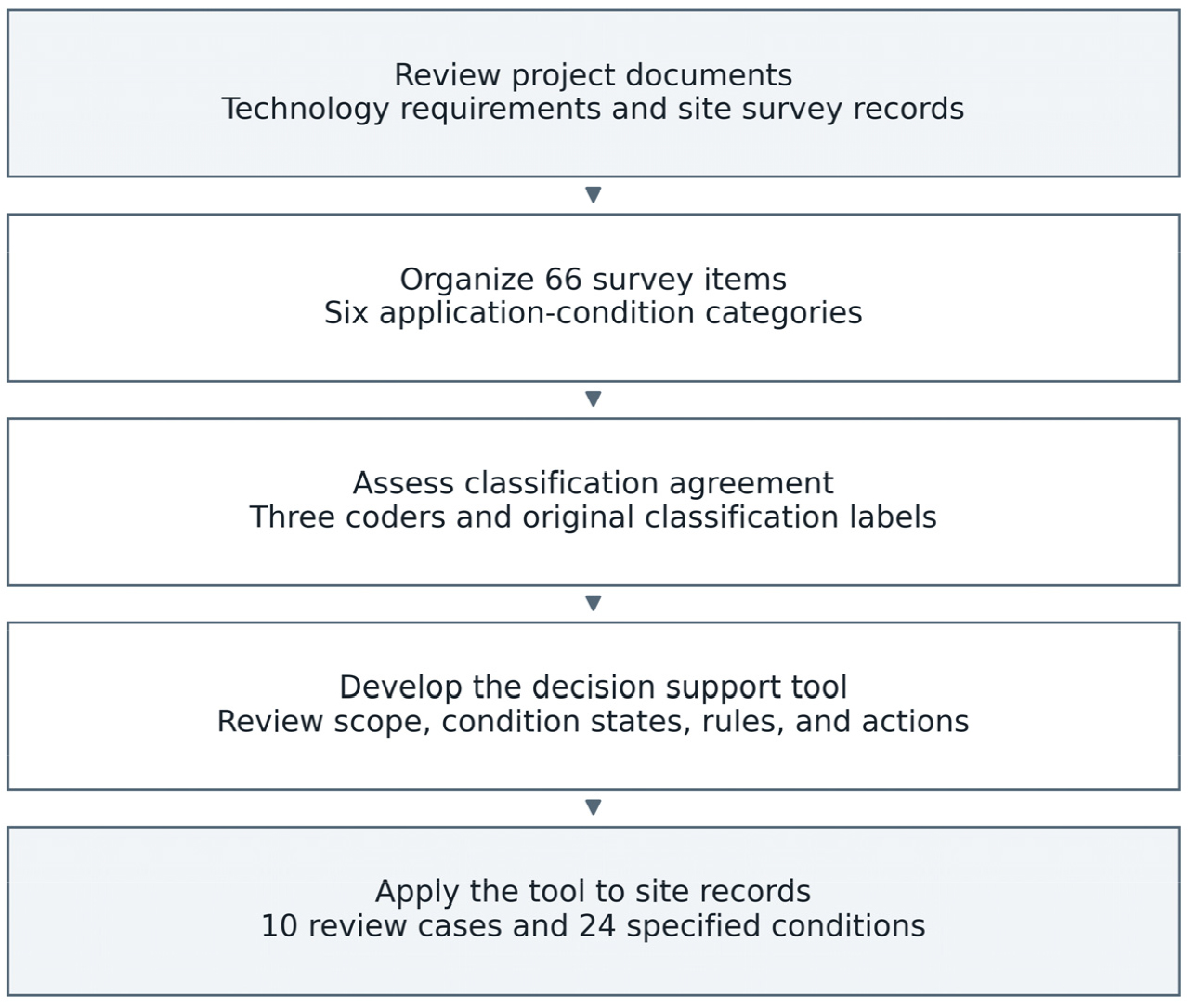
연구는 자료 검토, 문항의 범주화와 일치도 분석, 지원도구 구성, 후보단지 사례 적용의 순서로 수행하였다(Figure 1). 기존 조사표의 질문과 응답은 원자료로 유지하고, 지원도구에서 사용할 확인조건과 판단 규칙을 별도로 구성하였다.
https://cdn.apub.kr/journalsite/sites/kiaebs/2026-020-05/N0280200506/images/Figure_KIAEBS_20_5_06_F1.jpg
Figure 1.

Development procedure and case application of the decision support tool

기술별 요구 조건 정리

냉방과 난방은 실내환경, 설정값 및 운전상태를 바탕으로 운전조건을 조정하며, 환기는 재실 및 실내공기질에 따른 운전 최적화를 대상으로 한다. 조명과 가전은 재실 여부와 개별 부하의 상태 및 전력사용 정보를 활용한다. 공용부에 기술을 적용하려면 BAS의 운전정보와 전력사용량을 확보할 수 있는지, 어떤 설비를 제어할 수 있는지 확인해야 한다.

기술자료에서 냉방·난방·환기·조명 등의 입력변수, 제어정보 및 대표 수집주기를 정리하였다(Table 2). 이 값은 기술에서 요구하는 조건이며, 후보단지에서 실제로 확보한 데이터의 종류나 수집주기를 뜻하지 않는다.

Table 2.

Technology requirements and representative data collection intervals

Technology Required data and control information Representative collection interval
Cooling Indoor and outdoor temperature and humidity; occupancy; equipment electricity consumption; operating status and temperature setpoint Environmental variables and electricity consumption: 1 min; occupancy: 5 min; status and setpoint: 1 min or event-based, subject to confirmation
Heating Supply and return water temperatures; flow rate and heat consumption; room temperature, setpoint, and operating status Room temperature, setpoint, and status: 5 min; heat-meter variables: 15 min
Domestic hot water Household information; indoor and outdoor temperatures; hot-water setpoint and relevant operating status Household information: daily or updated when changed; selected temperature and status variables: 5 min; some requirements unresolved
Ventilation Temperature; CO2; PM2.5 and PM10; operating status, mode, and airflow Listed variables: 5 min
Lighting Switching history; occupancy and illuminance; household electricity consumption; lighting control signals Occupancy and illuminance: 5 min or event-based; switch status: event-based; household electricity consumption: 15 min
Appliances Appliance inventory; occupancy; smart-plug power and electricity consumption; power state Smart-plug power and electricity consumption: 5 min; occupancy: 5 min or event-based; power-state interval unspecified
Common-area systems BAS operating data; electricity consumption records; CCTV access 
where required; controllable equipment
System-specific; actual collection and logging intervals require site confirmation

적용조건의 범주 구성과 문항 분류

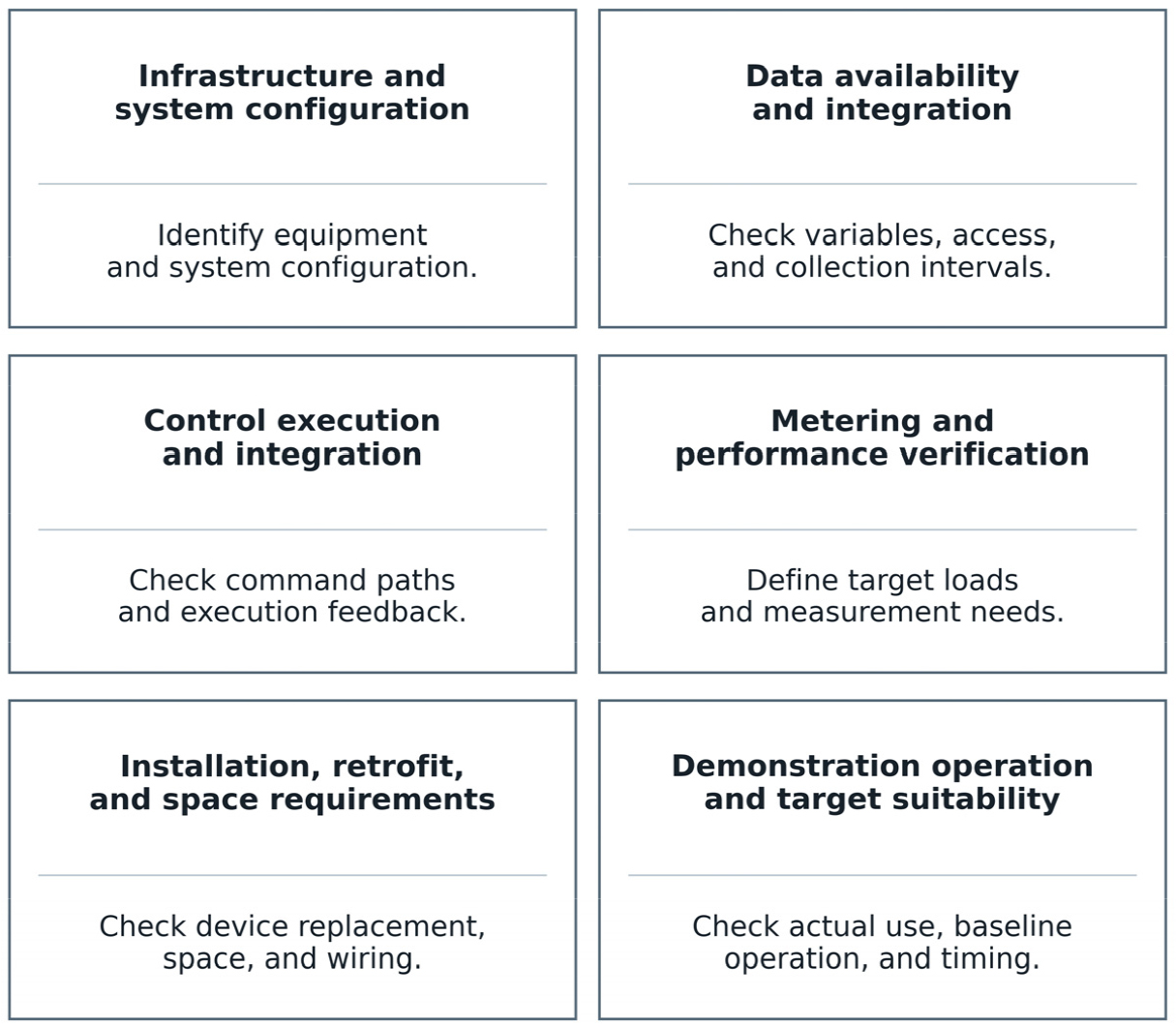
여섯 범주는 연역적 설정과 귀납적 보완을 결합하여 구성하였다. 먼저 기술요구조건의 분석축인 데이터 확보, 제어 실행, 성과검증 및 실증 적합성을 출발점으로 삼았다. 이어 조사문항의 확인목적을 검토하여 설비의 존재와 사양을 확인하는 문항과 추가 장치의 설치 여건을 확인하는 문항을 각각 기반 인프라와 설치·개조 조건으로 구분하였다. 이후 66개 문항에 적용하는 과정에서 둘 이상의 목적을 함께 묻는 경계문항을 검토하여 범주 간 경계를 조정하였다(Figure 2). 주 분석자는 각 문항의 주된 확인목적에 따라 하나의 범주를 부여하였다. 여러 확인사항을 함께 묻는 문항도 원문을 나누지 않고 한 문항으로 유지하였다.
https://cdn.apub.kr/journalsite/sites/kiaebs/2026-020-05/N0280200506/images/Figure_KIAEBS_20_5_06_F2.jpg
Figure 2.

Six application-condition categories used to select review conditions

범주 구분에서는 원격검침 데이터의 접근 가능 여부, 수집주기 및 보관기간을 확인하는 목적과 설비별 에너지 사용량을 따로 측정하거나 산정할 수 있는지를 확인하는 목적을 구분하였다. 설비의 운전상태를 조회하는 기능과 설정값을 변경하거나 작동명령을 보내는 기능도 구분하였다. 추가 장치의 설치공간과 배선은 설치조건으로, 실증대상 설비의 실제 사용 여부와 운영상 제약은 운영조건으로 검토하였다.

Table 3.

Application-condition categories and clarified classification criteria

Category Main purpose Distinction from related categories
Infrastructure and system configuration Identify existing equipment, manufacturers, capacity, and system configuration Equipment presence and design documents do not establish data access or control capability.
Data availability and integration Identify accessible variables, permissions, interfaces, collection intervals, and retention periods Reading status or setpoints is distinguished from issuing commands or changing setpoints.
Control execution and integration Identify control targets, command transmission and execution, external connections, and feedback Equipment presence and control-related data do not establish executable external control.
Metering and performance verification Define measurement boundaries, separately metered loads, conversion information, and measurements for evaluation Access to readings is distinguished from the ability to quantify energy use for the target load.
Installation, retrofit, and space requirements Check space, wiring, access, and compatibility for additional equipment or replacement Existing equipment specifications are interpreted in relation to the proposed installation or modification
Demonstration operation and target suitability Check actual use, operating schedules, existing control practices, and participation constraints Installed functionality is distinguished from actual operation and suitability for the planned demonstration.

Table 3에는 연구자 간 분류 차이를 검토한 뒤 보완한 구분 기준을 제시하였다. 이 기준에 따라 최초 분류값을 변경하지 않았다. 66개 조사문항의 영문 번역과 세 연구자의 최초 분류 결과는 부록 S1에 제시하였다.

전체 문항의 연구자 간 분류 일치도 분석

동료 연구자 2인은 먼저 범주별 분포를 고려해 선정한 20문항을 분류하고, 이후 나머지 46문항을 추가로 분류하였다. 두 단계 모두 동일한 범주 설명을 사용하였으며, 주 분석자의 분류값과 1단계의 일치도 결과는 제공하지 않았다. Table 3의 구분 기준은 66문항의 분류가 모두 끝난 뒤 불일치 문항을 검토하여 보완하였다. 일치도는 두 단계의 최초 분류값을 결합하여 전체 66문항에 대해 계산하였다. 세 연구자의 전체 일치도는 Fleiss’ κ로, 연구자 두 명씩 비교한 일치도는 Cohen’s κ와 단순 일치율로 산정하였다.

κ는 연구자들이 우연히 같은 범주를 선택할 가능성을 고려하여 분류의 일치 정도를 나타내는 지표이다. 두 연구자의 실제 일치율을 Pₒ, 각 연구자의 범주별 분류 비율로 계산한 우연 일치율을 Pₑ라 하면 Cohen’s κ는 다음과 같이 계산된다.

(1)
κ=(Pₒ−Pₑ)/(1−Pₑ)

세 연구자 전체의 일치도는 Fleiss’ κ를 사용하였다. 각 문항에서 연구자를 두 명씩 짝지어 구한 일치도의 평균을 P̄, 전체 분류 결과의 범주별 비율로 계산한 우연 일치도를 P̄ₑ라 하면 다음과 같이 계산된다.

(2)
κ=(P¯−P¯ₑ)/(1−P¯ₑ)

여섯 범주는 높고 낮음이나 순서가 없는 구분이므로, 범주 사이의 차이에 가중치를 부여하지 않았다.

의사결정 지원도구의 구성과 판단 기준

지원도구의 검토 단위는 단지 전체가 아니라 기술, 적용 대상 및 검토목적을 함께 정한 사례이다. 예를 들어 냉방 기술의 데이터 수집 준비와 주차장 조명의 기존 운전방식 식별은 서로 다른 검토범위로 등록한다. 범위를 정한 뒤 여섯 범주에서 필요한 조건을 선택하고, 요구조건의 근거와 관련 조사문항을 연결한다. 원문항 하나에서 여러 확인조건을 구성할 수 있으며, 이때 원조사표의 66문항 분류와 지원도구의 조건 수는 구분한다.

도구는 사례별 결과, 조건별 입력과 판단, 원조사자료 및 사용방법으로 구성한 스프레드시트로 구현하였다. 입력항목은 Table 4에 제시하였다. 수집주기를 수치로 비교할 때에는 요구 최대간격과 실제 간격을 분 단위로 입력하고, 실제 간격이 요구 최대간격 이하인지 계산한다. 실제값이 없으면 미확인으로 남긴다. 필요한 조치와 근거는 검토자가 입력하며, 도구가 조건별 결과와 미완료 사항을 집계한다. 입력 누락, 중복된 조건번호 및 잘못된 수치가 있으면 먼저 수정하도록 표시한다.

Table 4.

Fields of the decision support tool

Field group Recorded information Role
Review scope Technology, site, target equipment or dwelling type, and review purpose Defines the scope covered by the review outcome.
Required conditions Condition description, category, and source of the requirement Identifies the conditions relevant to the stated review purpose.
Site evidence Survey item, recorded response, explanatory notes, and additional records Preserves the evidence used to interpret each condition.
Condition status Met, unmet, or unresolved; required and actual collection intervals where applicable Distinguishes confirmed shortfalls from missing information.
Remedy feasibility Proposed action and evidence of feasibility or infeasibility Determines whether an unmet condition can be addressed.
Review output Condition-level and case-level outcomes and outstanding actions Supports target selection, data collection, baseline definition, and scheduling.

조건의 상태는 충족, 미충족, 미확인으로 입력한다. 명확한 부재가 기록되면 해당 조건을 미충족으로, 응답이 없거나 공급업체 확인 등의 전제가 남아 있으면 미확인으로 처리한다. 일반적인 있음 응답에 세대 유형별 예외가 기록되어 있으면 해당 유형의 특기사항을 함께 적용한다. 실제 접근이나 제어 실행을 확인하려는 조건에서는 장치 보유 또는 조건부 가능 응답만으로 충족을 부여하지 않는다.

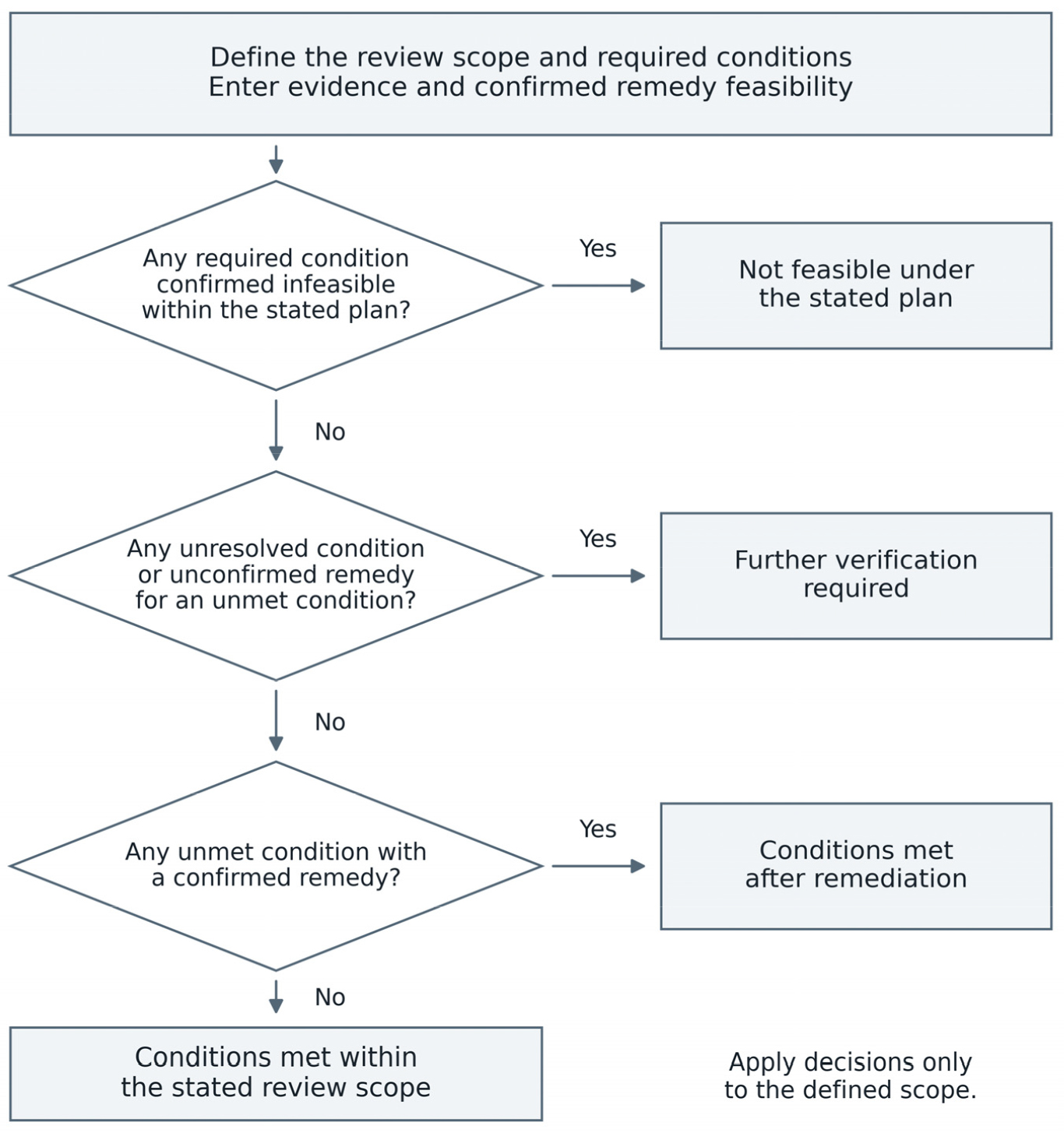
미충족 조건에는 필요한 조치와 보완 가능성을 함께 기록한다. 미충족 조건의 보완방법이 제안되어 있더라도 실행 가능성이 확인되지 않으면, 보완가능성을 미확인으로 기록한다. 도구는 각 조건과 사례별로 조건 충족, 보완 후 조건 충족, 추가 확인 필요, 현재 계획 적용 곤란의 결과를 제시한다. 보완 불가가 확인된 필수조건이 있으면 현재 계획 적용 곤란으로 판단한다. 그 외에는 미확인 조건 또는 보완 가능성의 미확인이 남아 있으면 추가 확인 필요로, 미충족 조건 모두의 보완방법이 확인되면 보완 후 조건 충족으로 판단한다. 등록한 조건이 모두 충족된 경우에 조건 충족으로 표시한다(Table 5, Figure 3). 판단 결과는 입력한 검토범위에 한정한다. ‘보완 후 조건 충족’은 보완방법의 실행 가능성이 확인되어, 해당 조치를 수행하면 조건을 충족할 수 있는 경우이다.

Table 5.

Decision rules for a defined review scope
Priority Review outcome Decision rule Follow-up action
1 Not feasible under the stated plan At least one required condition is unmet, and the absence of a feasible remedy is documented. Revise the target, method, or schedule.
2 Further verification required No required condition is confirmed infeasible, but at least one condition remains unresolved or an unmet condition lacks evidence of remedy feasibility. Obtain the missing evidence or test the proposed connection or remedy.
3 Conditions met after remediation At least one condition is unmet; feasible remedies are documented for all unmet conditions, and all remaining conditions are met Implement the remedies and update the review outcome.
4 Conditions met All conditions included in the defined review scope are met. Proceed within the reviewed scope.

https://cdn.apub.kr/journalsite/sites/kiaebs/2026-020-05/N0280200506/images/Figure_KIAEBS_20_5_06_F3.jpg
Figure 3.

Decision rules for the conditions included in a defined review scope

사례 적용과 도구의 계산 점검

후보단지 자료에서 설정온도 데이터, 세대별 제어장치, 계측주기, 운영데이터, 영상 접근, 기존 디밍 운전 및 시설 운영에 관한 검토사항을 선정하였다. 이를 10개 사례와 24개 확인조건으로 구성하여 도구에 입력하였다. 두 단지의 주차장 조명은 같은 검토범위를 각각 등록하였다. 사례 수는 독립적인 단지 수를 뜻하지 않으며, 제공된 자료에서 드러난 서로 다른 판단 상황을 설명하기 위한 구성이다. 각 조건의 요구사항과 현장기록을 대조하여 상태를 입력하고, 결과를 바탕으로 필요한 자료 확인과 보완조치를 정리하였다. 확인된 조건의 단순 개수로 기술의 중요도나 적용 우선순위를 산정하지 않았다. 보완 불가의 근거가 없는 미충족 조건은 곧바로 적용 곤란으로 판단하지 않았다. 도구의 계산은 충족·미충족·미확인, 보완 근거의 유무, 여러 조건의 결합, 수집간격의 경계값 및 입력 오류를 포함하는 시험 입력으로 점검하였다. 이 점검은 정한 규칙이 스프레드시트에서 의도대로 계산되는지 확인하는 과정이며, 현장 적용 결과에 대한 정확도 평가와 구분하였다.

사례 해석과 후속 조치의 적절성을 검토하기 위해 기술담당자 2인에게 조건별 입력내용, 판단 결과 및 후속 조치를 제시하고 의견을 수렴하였다. 조건의 누락, 자료 해석 및 후속 조치의 수정 필요성을 검토하였으며, Site A의 냉방, 조명, CCTV 및 주차장 조명 사례에 대한 의견을 반영하였다. Site B는 실증 협의가 진행 중이므로, 기술담당자의 의견은 추가 확인사항으로 기록하고 이를 확정된 현장자료로 사용하지 않았다.

분석결과

현장 실증 적용조건의 구성

주 분석자의 최초 분류를 기준으로 기반 인프라 및 시스템 파악은 15문항, 데이터 확보 및 연동은 16문항, 제어 실행 및 연동은 8문항, 계측 및 성과검증은 7문항, 설치·개조 및 공간조건은 10문항, 실증 운영 및 대상조건은 10문항이었다(Table 6). 문항 수는 조사표가 어떤 확인내용을 포함하는지 보여주는 구성정보이다. 지원도구에서는 이 분포를 가중치로 사용하지 않고, 적용 기술과 검토목적에 필요한 조건을 선택하였다.

Table 6.

Distribution of the 66 survey items by application condition

Category Common areas Dwelling units Total
Infrastructure and system configuration 11 4 15
Data availability and integration 8 8 16
Control execution and integration 5 3 8
Metering and performance verification 5 2 7
Installation, retrofit, and space requirements 6 4 10
Demonstration operation and target suitability 9 1 10
Total 44 22 66

전체 66개 문항의 연구자 간 분류 일치도

전체 66문항에 대한 세 연구자의 분류 일치도는 Fleiss’ κ=0.568로 중간 수준이었다(Landis and Koch, 1977).

Table 7.

Pairwise Inter-coder agreement for all 66 survey items

Comparison Agreed items Observed agreement Cohen’s κ
Primary coder and Coder A 48/66 72.7% 0.662
Primary coder and Coder B 43/66 65.2% 0.573
Coder A and Coder B 38/66 57.6% 0.470

연구자 두 명씩 비교한 Cohen’s κ는 0.470~0.662였다(Table 7). 분류 차이는 설비 설치 여부, 데이터 확보 및 제어 가능성을 함께 묻는 문항 등에서 나타났다. 이를 바탕으로 범주 구분 기준을 보완하였으며, 지원도구에서는 서로 다른 확인목적을 별도의 조건으로 기록할 수 있도록 하였다.

지원도구의 사례별 결과

10개 사례의 24개 조건 중 6개는 기록상 충족, 6개는 미충족, 12개는 미확인으로 입력되었다. 사례별 검토결과와 후속 조치는 Table 8에, 사례별 조건 상태와 전체 합계는 Table 9에 제시하였다. 이 수치는 선정한 검토조건의 상태를 설명하며, 전체 체크리스트의 응답률이나 현장 제약의 발생률을 의미하지 않는다. 주차장 조명의 기존 운전방식 식별 2개 사례는 정한 범위의 조건을 충족하였고, 나머지 8개 사례는 조건 또는 보완 가능성의 추가 확인이 필요하였다. Table 9의 조건 상태는 기존 조사기록에 근거한 사후 적용값이며, 이후 수렴한 기술담당자 의견은 확인자료가 확보되지 않은 경우 상태 변경에 사용하지 않고 후속 확인사항을 구체화하는 데 활용하였다.

냉방 데이터 수집을 검토한 Site A에서는 기기별 전력측정 가능 응답과 설정온도 데이터 미확보가 함께 확인되었다. 기술별 요구조건과 조사결과를 비교하여, 설정값의 확보경로와 실제 전력 수집간격 확인을 후속 조치로 정리하였다. Site B의 공용부는 실별 계량기를 월 1회 수기로 검침하고 있어, 월보다 짧은 제어구간을 평가하려면 자동검침 또는 추가 계측방법을 확인해야 했다. Site B의 기존 조사기록에는 BAS 계통도와 사양서를 제공할 수 있으나 운영데이터는 수집하지 않는 것으로 기재되어 있었다. 이후 기술담당자 검토에서는 방재실 PC에서 운영데이터를 확인하고 저장할 가능성이 제시되었다. 다만 구체적인 변수, 저장주기, 저장기간 및 외부 제공 가능 여부는 확인되지 않아 추가 확인이 필요한 조건으로 유지하였다.

세대 유형별 장치 차이는 대상 선정과 제어방식 검토에 연결되었다. Site B의 25A형은 밸브제어기 부재에 따른 제어 제약 가능성과 월패드 데이터의 최종 확인 필요가 기록되어 있었다. Site A의 26형은 스마트스위치로 교체할 수 있는 스위치가 없는 것으로 조사되었다. 두 사례 모두 대체 제어방법의 실행 가능성이 확인되지 않았으므로 추가 확인 필요로 남기고, 세대 유형별 장치 구성과 연결방법을 확인하도록 하였다. Site A의 CCTV는 Honeywell 장치가 기록되어 있고 RTSP 관리자 계정 확인을 조건으로 접근 가능하다고 되어 있었다. 도구에서는 장치 식별과 접근 확인을 분리하여 계정·이용권한 확인 및 접속시험을 후속 조치로 제시하였다. Site B의 공용부에서는 배전반 조작 가능 응답과 가로등·주차장 조명의 방재실 원격제어 부재가 대상별로 구분되었다. 이에 따라 제어할 회로와 외부 연결방법을 별도로 확인하도록 하였다.

Table 8.

Case application results and follow-up actions

Case and review scope Key recorded condition Review outcome Follow-up decision or action
A01: Cooling data collection Electricity measurement was reported as possible, but setpoint data were unavailable and the actual collection interval was unspecified. Further verification required Check air-conditioner availability and models in each dwelling, and confirm the setpoint data source and electricity collection interval.
B01: Heating control and data for Type 25A No valve controller was identified under the sink; the control route and access to wall-pad data remained unresolved. Further verification required Verify the control route by dwelling type and obtain sample control and wall-pad data.
A02: Lighting control for 
Type 26
No switch suitable for replacement was reported, and wall-pad integration remained unresolved. Further verification required Confirm the connection method and dwelling compatibility of the alternative control approach identified during technical review.
B02: Sub-monthly electricity evaluation Separate room meters were available, but they were read manually once a month. Further verification required Define the required evaluation interval and examine automatic reading or additional metering.
B03: BAS data analysis The existing survey record stated that operating data were not being collected. Subsequent technical review indicated that data might be viewable and stored on the disaster-prevention control-room PC, but this has not yet been confirmed. Further verification required Verify the available variables, logging and retention periods, export format, and permission for external data access.
B04: Common-area lighting control Electrical-panel operation was possible, but streetlights and parking lights could not be remotely controlled from the disaster-prevention room. Further verification required Map the target circuits and examine an external connection method for the proposed control.
A03: CCTV data access Honeywell equipment was recorded, but RTSP access depended on administrator credentials and permissions. Further verification required Clarify permitted video use and de-identification methods, then verify an authorized data collection method.
A04: Identification of baseline operation Parking-light dimming was already in operation at Site A. Conditions met within the stated scope Use the dimming operation currently implemented at Site A as the site-specific baseline.
B05: Identification of baseline operation Parking-light dimming was already in operation at Site B. Conditions met within the stated scope Use the existing dimming operation as the baseline operating mode.
B06: Evaluation during facility operation The community facilities were not in operation, and the date of future operation was uncertain. Further verification required Select a facility currently in operation or revise the evaluation schedule.
Table 9.

Condition-status counts based on the candidate-site records

Case Site and application Met Unmet Unresolved Total
A01 Site A: Cooling 1 1 1 3
B01 Site B: Heating, type 25A 0 0 4 4
A02 Site A: Dwelling lighting, type 26 0 1 1 2
B02 Site B: Common-area metering 1 1 1 3
B03 Site B: BAS data analysis 1 1 1 3
B04 Site B: Common-area lighting control 0 1 2 3
A03 Site A: CCTV data access 1 0 1 2
A04 Site A: Parking-light baseline 1 0 0 1
B05 Site B: Parking-light baseline 1 0 0 1
B06 Site B: Community-facility operation 0 1 1 2
Total 6 6 12 24

기존 운전방식과 시설 이용 여부는 성과평가 조건에도 영향을 주었다. 두 단지의 주차장 조명은 기존 디밍 운전이 기록되어 있어 기존 제어방식의 식별이라는 범위에서 조건 충족으로 판단되었다. 이에 따라 기존 디밍 운전을 비교기준으로 설정할 수 있었다. 이 결과는 신규 조명 기술의 제어 성능이나 절감량 평가를 완료했다는 의미가 아니다. Site B의 커뮤니티 시설은 미운영이고 운영 개시도 불확실하여, 운영 중인 대상을 선정하거나 개시 이후로 평가일정을 조정하는 검토가 필요하였다. 이후 기술담당자 2인의 검토를 통해 Site A 사례의 후속 조치를 구체화하였다. 냉방은 세대별 에어컨 보유 여부와 기종을 추가로 확인하도록 하였다. 26형 조명은 기존 스위치의 교체 제약과 대체 제어방식의 적용 가능성을 구분하여 확인하도록 하였다. CCTV는 영상 제공 가능 범위와 개인을 식별할 수 없도록 처리하는 방법을 확인하도록 보완하였다. 주차장 조명은 해당 단지에서 실제 적용 중인 디밍 운전을 비교기준으로 명시하였다.

판단 규칙의 구현 결과

시험 입력에 대한 계산 점검에서는 미충족 조건에 보완 가능 표시만 입력하고 근거를 남기지 않은 경우 추가 확인 필요가 유지되었다. 한 조건의 보완방법을 확인해도 다른 미확인 조건이 남아 있으면 사례 결과가 조건 충족으로 바뀌지 않았다. 수집간격은 요구값과 같은 경우 충족으로, 이를 초과하면 미충족으로, 실제값이 없으면 미확인으로 처리되었다. 이러한 기능은 보완 제안과 확인된 보완방법을 구분하고, 일부 조건의 확인만으로 사례 전체가 완료되는 것을 방지하였다.

논 의

기존 체계와의 관계 및 연구의 기여

기존 연구와 평가체계에서는 건물의 자동제어 기능, 스마트 기술 활용 수준 및 에너지 절감성과를 다루어 왔다. IBACSA는 건물 자동화·제어시스템의 기능과 스마트화 수준을 점검하는 도구이며(Engelsgaard et al., 2020), SRI는 건물이 스마트 기술을 활용할 수 있는 수준을 평가한다(European Commission, 2020; European Commission, 2024). IPMVP는 측정 범위와 비교기간 사이의 조건 변화를 고려하여 절감량을 검증하는 방법을 제시한다(Efficiency Valuation Organization, 2024). 이러한 개념은 현장에서 확인할 항목을 정하는 데 활용할 수 있으나, 특정 기술의 실증 준비 단계에서 조사기록을 요구조건과 대조하여 판단과 후속 조치로 연결하는 절차를 직접 다루지는 않는다.

본 연구는 현장실증의 특정 기술과 검토목적에 대해 요구조건, 조사기록, 판단 및 후속 조치를 연결하는 도구를 구성하였다. 설비 보유 여부와 자료 접근 가능성, 실제 제어 기능 및 계측 여건을 서로 다른 조건으로 기록하고, 조건의 부재와 미확인을 구분하여 다음 조치에 반영하였다. 본 연구는 현장조사 결과를 기술별 요구조건과 비교하고, 부족하거나 확인되지 않은 조건을 실증 준비에 필요한 조치로 연결하는 절차를 제시하였다.

사례 적용에서는 같은 있음 응답도 질문의 목적과 특기사항에 따라 다르게 해석해야 했다. 냉방 전력측정 가능 응답은 설정온도 데이터의 확보를 보장하지 않았고, 월패드 연동과 CCTV 접근의 조건부 응답에는 최종 확인과 접속시험이 남아 있었다. 도구는 이러한 차이를 별도 조건과 근거로 기록하여 검토자가 판단의 이유를 확인하고 자료 확보 후 결과를 갱신할 수 있도록 하였다.

또한 전체 66개 문항의 분류 결과와 연구자 간 판단이 달라진 문항을 제시하여 분류 과정을 확인할 수 있도록 하였다. 이는 후속 조사에서 여러 내용을 함께 묻는 문항을 나누고, 질문의 확인목적을 구체화하는 근거가 된다.

현장 적용과 가이드라인 활용

실무에서는 적용 기술과 대상 세대를 정한 뒤 관련 조건을 등록하고, 현장 응답을 자료 확인·설치 검토·접속시험 등의 조치로 연결할 수 있다. 새로운 자료를 확보하면 해당 조건의 상태와 근거를 갱신하며, 다른 조건의 미확인 여부도 함께 확인한다. 이를 통해 기술 담당자와 현장 관리자가 필요한 자료 및 작업 범위를 공유할 수 있다.

검토범위는 결과를 해석하는 기준이 된다. 기존 운전방식 식별이 목적이면 디밍 적용 기록을 근거로 비교기준을 정할 수 있지만, 신규 제어 기술의 실증 착수를 검토하려면 데이터·제어·계측·설치·운영 조건을 추가해야 한다. 본 도구는 기술별 조건을 추가할 수 있는 구조로 구성하였으며, 사례 적용에서 사용한 조건을 모든 기술에 동일하게 적용하지 않는다.

연구의 한계

분석자료는 한 연구과제의 체크리스트와 두 단지의 조사기록이므로 기술과 단지의 다양한 조건을 모두 포함하지는 않는다. 문항 분류의 일치도는 중간 수준이었고, 보완한 범주 구분 기준을 다시 독립적으로 적용하여 평가하지 않았다. 또한 범주의 출발점이 된 기술요구조건과 분석대상 조사문항이 모두 같은 연구과제에서 작성되었으므로, 범주 설정에 해당 과제의 기술적 관점이 반복 반영되었을 가능성을 배제할 수 없다. 따라서 도출된 범주는 본 과제의 요구조건을 구조화한 결과로 해석해야 한다.

지원도구의 사례 적용은 기존 기록에 대한 사후 검토이며, 기술담당자 2인의 비교검토를 통해 사례 해석과 후속 조치를 보완하였다. 다만 도구의 판단을 제시한 상태에서 의견을 수렴하였으므로 독립적인 판단 정확도를 평가한 것은 아니다. 실제 설치·제어 결과에 따른 판단의 적절성과 자료 확인시간 단축 등의 효과는 후속 연구에서 평가할 필요가 있다. 후속 실증에서 필요한 조치의 수행 여부와 기술 적용 결과를 연결하여 도구의 유용성을 평가할 필요가 있다. 본 연구의 기축 공동주택은 준공 후 운영 중인 주택을 의미하며, 준공연도와 설비 구성이 다른 단지로 적용을 확대할 필요가 있다.

결 론

본 연구는 기축 공동주택 에너지관리 기술의 현장실증을 준비하기 위한 의사결정 지원도구를 개발하고, 두 후보단지의 조사기록에 적용하였다. 66개 조사문항을 여섯 적용조건으로 정리하고, 기술별 요구조건과 현장기록을 비교하여 조건의 상태와 필요한 조치를 기록하는 구조를 구성하였다.

첫째, 도구는 기술과 검토목적에 맞는 조건을 선택하고, 충족·미충족·미확인 상태와 보완 가능성을 구분하여 검토결과를 제시한다. 보완방법의 근거와 다른 미확인 조건을 함께 반영하므로, 설비 보유 또는 일부 기능의 확인만으로 전체 검토가 완료되는 것을 방지할 수 있도록 구성하였다.

둘째, 사례 적용을 통해 냉방 설정값의 확보경로, 세대 유형별 제어장치와 스위치 교체 가능성, 공용부 계측주기, BAS 운영데이터 및 영상 접근에 필요한 후속 조치를 도출하였다. 이는 조사결과를 대상 선정, 추가 수집 및 연결방법 검토에 활용하는 구체적인 절차를 보여준다.

셋째, 기존 디밍 운전과 미운영 시설의 기록을 각각 비교기준 설정과 평가일정 검토에 연결하였다. 조건 충족 여부는 정한 검토범위에서 해석하도록 하여, 기존 운전방식의 식별과 신규 기술의 실증 준비를 구분하였다.

개발한 도구는 현장조사에서 확인된 정보와 남은 확인사항을 실증계획의 판단 및 조치로 연결하는 데 활용할 수 있다. 후속 연구에서는 추가 단지와 실제 기술 적용 결과를 이용하여 판단의 적절성과 현장 활용효과를 평가할 필요가 있다.


Acknowledgements

본 연구는 기후에너지환경부(MCEE)와 한국에너지기술평가원(KETEP)의 지원을 받아 수행한 연구 과제입니다(No. RS-2024-00398693).

References

1

Akbulut, L., Taşdelen, K., Atılgan, A., Malinowski, M., Coşgun, A., Şenol, R., Akbulut, A., Petryk, A. (2025). A systematic review of Building Energy Management Systems (BEMSs): Sensors, IoT, and AI integration. Energies, 18(24), 6522.

10.3390/en18246522
2

Domingues, P., Carreira, P., Vieira, R., Kastner, W. (2016). Building automation systems: Concepts and technology review. Computer Standards & Interfaces, 45, 1-12.

10.1016/j.csi.2015.11.005
3

Engelsgaard, S., Alexandersen, E.K., Dallaire, J., Jradi, M. (2020). IBACSA: An interactive tool for building automation and control systems auditing and smartness evaluation. Building and Environment, 184, 107240.

10.1016/j.buildenv.2020.107240
4

Gunay, B., Markus, A., Parsaei, A., Darwazeh, D., Bursill, J., Pellerin, L. (2025). A critical review of field implementation of data-driven operation and maintenance technologies to reduce building energy use and GHG emissions. Energy and Buildings, 346, 116087.

10.1016/j.enbuild.2025.116087
5

Hwang, J.-H., Song, D.-S., Lee, T.-W. (2020). A study on the analysis and diagnosis of electricity consumption characteristics in a research building using BEMS data. Journal of KIAEBS, 14(6), 613-625.

6

Kwak, R.-Y. (2013). Feasibility evaluation and process proposal for the application of BEMS to existing office buildings. Journal of the Architectural Institute of Korea, 29(11), 299-306.

7

Landis, J.R., Koch, G.G. (1977). The measurement of observer agreement for categorical data. Biometrics, 33(1), 159-174.

10.2307/2529310
8

Lee, Y.-A., Kwag, B.C., Ha, H., Kim, G.-T. (2025). Analysis of BEMS applicability in existing multi-family housing based on facility and communication infrastructure. Journal of the Korean Society of Living Environmental System, 32(5), 541-552.

10.21086/ksles.2025.10.32.5.541
9

Park, S.C., Ha, J., Kim, H.Y., Song, Y.H. (2018). Analysis of the operational status of a library building using BEMS data: Building energy performance evaluation at the early stage after completion. Journal of KIAEBS, 12(6), 669-679.

10

Peiris, S., Lai, J.H.K., Kumaraswamy, M.M., Hou, H. (2023). Smart retrofitting for existing buildings: State of the art and future research directions. Journal of Building Engineering, 76, 107354.

10.1016/j.jobe.2023.107354
11

Ha, H., Lee, Y.-A., Lee, B.-H., Kwag, B.C., Kim, G.-T. (2025). A study on the design of a survey tool for BEMS application in existing multi-family housing: Focused on field surveys and interviews. Proceedings of the 2025 Autumn Annual Conference of the Korean Institute of Architectural Sustainable Environment and Building Systems, 167-168.

12

European Commission. (2020). Commission Delegated Regulation (EU) 2020/2155 of 14 October 2020 supplementing Directive 2010/31/EU by establishing an optional common European Union scheme for rating the smart readiness of buildings. Official Journal of the European Union, L 431, 9-24.

13

Efficiency Valuation Organization (EVO). (2024). International Performance Measurement and Verification Protocol (IPMVP). Available at: https://evo-world.org/en/products-services-mainmenu-en/protocols/ipmvp [Accessed on 12/09/2026].

14

European Commission. (2024). Smart readiness indicator. Available at: https://energy.ec.europa.eu/topics/energy-efficiency/energy-performance-buildings/smart-readiness-indicator_en [Accessed on 12/09/2026].

Appendix S1. Classification of the 66 survey items

Appendix S1. Classification of the 66 survey items

본 부록에는 66개 조사문항의 영문 번역과 세 연구자의 최초 분류 결과를 수록하였다. 본문 집계에는 주 분석자의 분류 결과를 사용하였다. Table S1a의 경계 문항 해석은 수정 과정에서 작성한 것으로, 분류 일치도 재계산에는 사용하지 않았다.

Category codes

I Infrastructure and system configuration
D Data availability and integration
C Control execution and integration
M Metering and performance verification
P Installation, retrofit, and space requirements
O Demonstration operation and target suitability

CA: 공용부, DU: 세대부, A와 B: 후보단지 Site A와 Site B가 아니라, 두 명의 독립적인 비교 분류자(Coder A, Coder B)를 의미함

Table S1.

English translations of the survey items and original classifications

No. Area Survey item (English translation) Primary A B
1 CA Whether CTTS is in operation I O I
2 CA Whether an operating agreement for parallel operation with KEPCO has been concluded O O D
3 CA Rated generating capacity of the emergency generator I I I
4 CA Operator of the electric vehicle chargers I I D
5 CA Space availability and installation feasibility for electric vehicle chargers supporting V2G P P P
6 CA Availability of external access to photovoltaic generation data and interface specifications D D I
7 CA Photovoltaic inverter manufacturer and generation capacity I I I
8 CA Whether surplus photovoltaic electricity occurs (photovoltaic generation minus common-area electricity consumption) O M O
9 CA Availability of remote reading of the main electricity meter D D M
10 CA Instrument transformer (MOF) ratio for the main electricity meter M I I
11 CA Feasibility of integration with KEPCO Power Planner (KEPCO Enter) D M D
12 CA Whether a separate industrial electricity meter is provided for common areas M I D
13 CA Types and number of electricity meters for common areas M I M
14 CA Presence of separate electricity meters for individual common-area utility facilities and availability of remote reading M I D
15 CA BAS manufacturer I I D
16 CA Availability of an open BAS integration interface and its protocol D D D
17 CA Feasibility of integration with common-area lighting control equipment and interface specifications C C C
18 CA Whether an HVAC system is in operation and its integration protocol C C C
19 CA Presence of a control device for the EHP system (system air conditioning) C C C
20 CA Availability of drawings I P I
21 CA Availability of installation space for a site EMS server rack P P P
22 DU Manufacturer of the home-network server or wall pad I I C
23 DU Feasibility of integration with the home-network server or wall pad and its protocol D D D
24 DU Types of sensor data that can be collected through the wall pad D D C
25 DU Types of equipment that can be controlled through the wall pad C I C
26 DU Manufacturer of the remote meter-reading system I I D
27 DU Types of data available through remote meter reading D D M
28 DU Remote meter-reading interval D D D
29 DU Presence of a decorative feature wall P I P
30 DU Distribution-board configuration and feasibility of installing additional meters P P P
31 DU Retention period of remote meter-reading data for dwelling units D D D
32 DU Standby-power cutoff device I I O
33 DU Resident complaints related to energy O O O
34 DU Lighting capacity in the dwelling unit (W) I I I
35 DU Whether the wall pad is integrated with SmartThings or ThinQ C C C
36 DU Locations and number of lighting switches that can be replaced with smart switches when wall-pad lighting control is unavailable P P P
37 DU Availability of heating setpoint and operating-status data at the time of control D D D
38 DU Availability of room-by-room indoor temperature data through wall-pad integration D D M
39 DU Availability of heating remote meter-reading data at 15-minute intervals M D D
40 DU Feasibility of installing CT sensors for lighting circuits in the distribution board P P P
41 CA Availability of automatic-control schedules and system diagrams I D I
42 CA Availability of equipment specifications and design information for common-area systems I I I
43 CA Whether common-area equipment data are collected and how long they are retained D D M
44 CA Data items collected from common-area equipment D D D
45 DU Availability of cooling equipment setpoint data at the time of control D D D
46 DU Feasibility of measuring electricity consumption for each cooling unit M M M
47 DU Presence of ventilation equipment in the dwelling unit and availability of control data C D I
48 CA CCTV model and manufacturer I I D
49 CA Availability of access to CCTV video storage D D D
50 CA Feasibility of wiring work to use the existing CCTV system P P P
51 CA Illuminance in the underground parking area O M I
52 CA Presence and current status of dimming-controlled lighting O C I
53 CA Inventory of controllable equipment in each room of the community facilities O C C
54 CA Lighting switch dimensions P I P
55 CA Switchboard drawings and electrical power layout drawings I I I
56 CA Electricity consumption by common-area electrical system M M M
57 CA Common-area systems and equipment with high electricity consumption O I I
58 CA Management of common-area electricity data, availability of historical records, and accessible data items D D D
59 CA Whether electrical leakage, power outages, and other abnormal events are recorded O O O
60 CA Locations of common-area switchboards and the systems or equipment connected to each switchboard I I I
61 CA Whether common-area switchboards can be operated or controlled C C C
62 CA Availability of remote control of streetlights and underground parking lights from the disaster-prevention room C C C
63 CA Frequency and arrangements of use for each room of the community facilities, including reservation systems O O O
64 CA Permitted working hours, including community-facility closure days O O P
65 CA Availability of space for demonstration equipment in each room of the community facilities P P P
66 CA Extent of wiring work and precautions, including obstacles, for each room of the community facilities P P P

전체 66개 문항 중 세 연구자가 모두 같은 범주로 분류한 문항은 34개였고, 두 연구자만 같은 범주로 분류한 문항은 27개였다. 세 연구자가 모두 서로 다르게 분류한 문항은 5개였으며, 전체 Fleiss’ κ는 0.568이었다.

Table S1a.

Interpretation of items with three different classifications

No. Primary/A/B Clarification for subsequent surveys
12 M / I / D Distinguish meter presence, the load measured, and access to readings.
14 M / I / D Separate questions about meters for individual facilities, measurement boundaries, and remote reading.
47 C / D / I Separate ventilation equipment presence, readable variables, and executable commands.
51 O / M / I Specify the purpose, location, and timing of illuminance measurement and the relevant operating conditions.
52 O / C / I Distinguish installed dimming equipment, current operation, and the ability to execute external commands.
페이지 상단으로 이동하기